
For property owners in the Taft area who need to clear trees and brush without the time and cost of hauling piles of debris off-site, forestry mulching is often the cleanest, fastest option available. MBP Land Clearing operates a professional mulching head capable of shredding trees, brush, and undergrowth in a single pass — leaving the material on the ground as a natural, weed-suppressing mulch layer. We work on residential lots, agricultural acreage, fence lines, and right-of-ways throughout Lincoln County, TN and into Madison County, AL. Call (931) 993-6081 for a free on-site estimate.
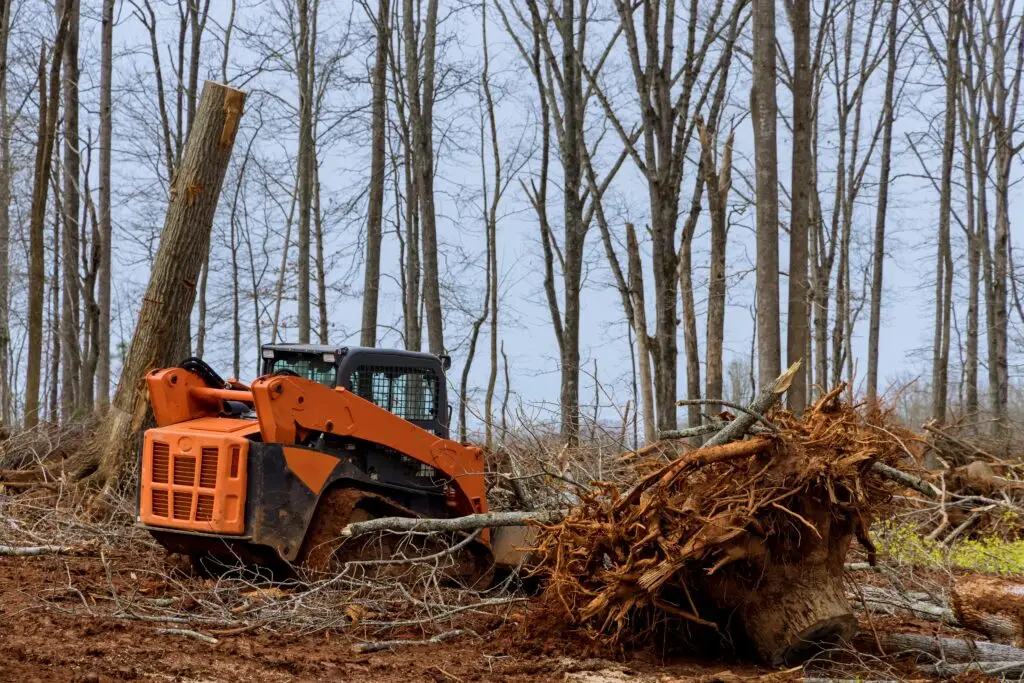
Forestry mulching is a single-machine land clearing method that uses a specialized mulching head attachment — mounted on a tracked skid steer or forestry machine — to shred trees, brush, and undergrowth in one efficient pass, leaving the shredded material on the ground as a natural mulch layer. There’s no hauling, no burning, and no large debris piles — the mulch stays in place, suppresses weed regrowth, reduces surface erosion, and gradually breaks down to enrich the soil. Unlike traditional land clearing, which involves cutting, piling, and hauling material away, forestry mulching keeps everything on-site and minimizes ground disturbance. MBP Land Clearing’s mulching head is capable of processing trees up to 6 to 8 inches in diameter, making it well-suited for overgrown fence lines, cedar-choked pastures, wooded acreage, and properties where the owner wants a clean, open look without heavy soil disruption. The machine works in overlapping passes across the property, shredding everything in its path. For properties in the rolling terrain of Lincoln County and the Tennessee Valley where soil runoff is a real concern, this method is often the environmentally preferable and cost-effective choice.
Brent Patterson walks the property to evaluate tree density, species composition, ground conditions, and machine access routes. This determines whether forestry mulching is the right method for your project or whether a combination approach — mulching some areas, traditional land clearing in others — makes more sense for the terrain and your end goals.
The mulching machine is staged on firm, level ground for equipment access. Any areas that need to be avoided — established trees you want to keep, drainage channels, property boundaries — are marked before the pass begins. Everything in the path of the mulching head gets processed, so marking this carefully upfront protects what you want to preserve.
The machine works in systematic overlapping passes across the designated area, processing trees, shrubs, brush, and undergrowth in a single motion. The mulching head shreds material down to wood chips and organic debris, depositing it evenly across the cleared surface. Most residential lots clear in a single day.
After the machine passes, Brent walks the cleared area to identify any spots that need a second pass — large stumps that need additional attention, areas where mulch is uneven, or sections near property lines that need a more precise touch. The goal is a consistently clean, finished look across the entire work area.
Once cleanup is complete, you walk the property with Brent to confirm the result meets your expectations. The mulched surface is typically ready for immediate use — seeding for pasture, running fence, or simply opening up the view. No waiting for debris to be hauled, no burn pile cleanup required.
MBP Land Clearing provides forestry mulching throughout Lincoln County, TN and into northern Alabama. We regularly work in Taft, Ardmore, Fayetteville, and Frankewing, as well as the rural properties along State Route 110 and US-431. Properties near Huntsville and Madison County, AL are well within our 60-mile service area.
Forestry mulching is particularly effective on the cedar-heavy and mixed hardwood lots that are common throughout this region. Properties that go unmaintained for a few seasons can become heavily overgrown quickly. We have the right equipment and technique for what grows in this part of Tennessee and Alabama. See all of our land management services on our Services page.

Brent Patterson has operated mulching and land clearing equipment for over 10 years and understands how terrain, soil type, and vegetation density affect the outcome of a mulching job. In the rolling country of Lincoln County, where tree density and ground moisture vary significantly across a single property, that experience translates into a better result — fewer ruts, more even coverage, and a finished surface that holds up.
MBP Land Clearing is fully insured, owner-operated, and offers free estimates on every project. We offer discounts for seniors, military members, and veterans. To learn more about our crew and how we approach land management work, visit our About Us page.
Forestry mulching keeps organic material on-site rather than hauling it to a landfill or burning it — which aligns with best practices promoted by conservation agencies. The mulch layer controls erosion and retains soil moisture, a benefit on properties that slope toward waterways. For guidance on responsible land management near streams in Tennessee, the Tennessee Department of Environment and Conservation provides state-level guidance on land disturbance and erosion control.
Over 10 years of hands-on land clearing and excavation experience you can trust.
We focus on doing the job right the first time — with attention to detail on every project.
When you call MBP Land Clearing, you work directly with the owner from start to finish.
We offer free estimates along with discounts for seniors, military members, and veterans.
MBP Land Clearing provides forestry mulching throughout Lincoln County, TN and into northern Alabama. We regularly work in Taft, Ardmore, Fayetteville, and Frankewing, as well as the rural properties along State Route 110 and US-431. Properties near Huntsville and Madison County, AL are well within our 60-mile service area.
Forestry mulching is particularly effective on the cedar-heavy and mixed hardwood lots that are common throughout this region. Properties that go unmaintained for a few seasons can become heavily overgrown quickly. We have the right equipment and technique for what grows in this part of Tennessee and Alabama. See all of our land management services on our Services page.
Forestry mulching uses a single machine with a rotating drum head to grind trees, brush, and undergrowth in place, turning them into mulch that stays on the ground. Traditional land clearing involves cutting, piling, and hauling debris away — which is more labor-intensive and leaves the soil more exposed. Mulching is generally faster, less disruptive, and more cost-effective when hauling isn’t required.
MBP’s mulching head handles trees up to 6 to 8 inches in diameter efficiently. Larger trees may need to be felled first before the mulching head can process them. During the site walk, Brent will assess the tree mix on your property and recommend the right approach.
Forestry mulching is typically priced per acre and varies based on tree density, terrain, and machine access. Lightly wooded or brushy acres cost less than dense, multi-layer canopy. MBP provides free on-site estimates — the most accurate pricing comes from walking the actual property.
No. The mulch stays on the ground and naturally decomposes over time. It suppresses weed growth, reduces erosion, and improves soil health as it breaks down. Most property owners find the finished look clean and uniform — no piles to deal with, no hauling required.
A typical residential lot or 1- to 2-acre parcel clears in a single day. Larger acreage and denser vegetation will extend the timeline. Brent provides a realistic time estimate during the on-site assessment.